Posts

TRAVEL2 - Rim to Rim at the Grand Canyon
Image
A few years ago, for my 70 th birthday, Pat took me to the NCAA Basketball Final Four Tournament in Indianapolis.   This year, for her 70 th birthday, I took Pat to her favorite natural wonder, the Grand Canyon. In 1861, in an official report about a government expedition to the Grand Canyon, topographical engineer Lieutenant Joseph Ives said, “Ours has been the first and will doubtless be the last to visit this profitless locality.”   Despite this shortsighted condemnation, the Grand Canyon became a U.S. National Park in 1919, and in 2017 hosted over six million visitors from all over the world. So here is the story of Pat’s and my August 2018 rim-to-rim expedition to the Grand Canyon.   I hope you’re not expecting an account of a rough trail hike from one rim, down to the Colorado River, and up the other side to the opposite rim.   Get real - we’re over 70 years old!   What follows is the story of our road trip from Tucson to the south rim of the Gra...
HISTORY5 - Crazy Horse Forever

Image
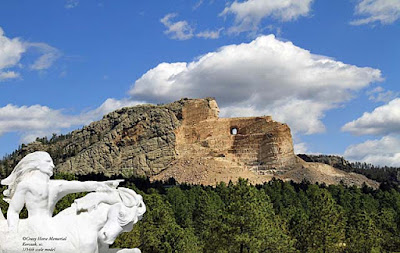
That Western National Parks tour, which I mentioned in my last article on the history of Mount Rushmore, also stops at the Crazy Horse Memorial, another place I have never been, so I wanted to learn about it too, before our visit in September. The Crazy Horse Memorial is a mountain monument, started in 1948 and still under construction on private land in the Black Hills of South Dakota, just over 16 driving miles from the Mount Rushmore Memorial.  The Oglala Lakota warrior, Crazy Horse, is being depicted riding a horse and pointing into the distance, in a gigantic 641 feet long x 563 feet high sculpture.  The memorial was commission by Henry Standing Bear, a Lakota elder, and designed and initially sculpted by Korczak Ziolkowski.  The project is operated today by the Crazy Horse Memorial Foundation. The incomplete Crazy Horse Memorial sculpture as it appears today.  Note the 1/34th scale model in the left foreground. Crazy Horse (1840-1877) Cra...

HISTORY4 - Mount Rushmore Rocks!

Image
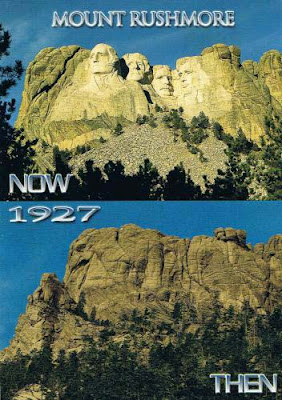
Pat and I are signed up for a tour in September that includes Yellowstone and Grand Teton National Parks and Mount Rushmore National Memorial.  I’ve never been to Mount Rushmore before, so ahead of the trip, I wanted to know more about Mount Rushmore’s history - hence this article as a “learning tool.”  I will write about the tour - complete with our best photos - after the trip. Mount Rushmore is a U.S. National Memorial located in the Black Hills of South Dakota.  It features spectacular 60-foot sculptures of the heads of four prominent U.S presidents:  George Washington, Thomas Jefferson, Abraham Lincoln, and Theodore Roosevelt.  Construction began in 1927 and lasted until 1941.  Sculptor Gutzon Borglum designed and oversaw the project. Before and after views of the Mount Rushmore carvings. The Idea In 1923 South Dakota State Historian Doane Robinson suggested carving the likenesses of famous people into the Black Hills region of Sou...

FAMILY1 - Sports Injury

Image
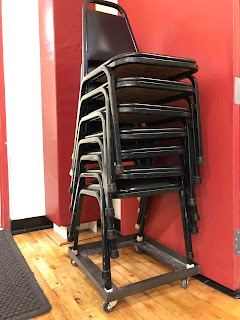
This is my story … and I’m sticking to it.  Last January 15 th , during a period of intense sporting activity, I fell and broke my wrist; hence the title of this story.  Okay, it didn’t happen during intense activity.  In fact I was barely moving.  I was at my YMCA gym.  My Silver Sneaker class had just ended and I was putting my chair away, stacking it on other chairs, the whole chair tower rising from a small four-wheeled steel support frame used to move the chairs around. After placing my chair in the stack, I turned to leave and tripped and fell over another of those wheeled chair supports - this one empty of chairs. Stack of gym chairs. This is the beast I tripped over and fell on. So my “sports injury” was breaking both bones in my left wrist and dislocating my left pinkie finger.   It took some time to realize that I probably had more than a sprained wrist.  So Pat and I arrived at Tucson Medical Center’s Emergenc...

TRAVEL1 - Chicago, My Kind of Town

Image
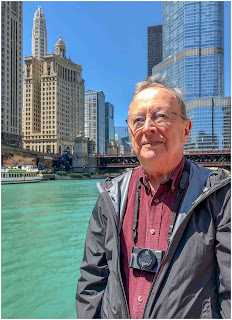
Pat and I try to travel a lot, under the theory that “do it while we still can.”  In May we reached deep into our “bucket list” and selected a trip to Chicago.  Neither of us had ever been to the windy city before, having only stopped briefly at O’Hare or Midway airports on cross country trips.  We scheduled this trip so that we could attend an afternoon Cubs baseball game.  Other top-of-the-list objectives included taking Chicago’s famous Architecture Tour and sampling Chicago’s classic food, including deep-dish pizza, hot dogs, Italian beef, and steak.  So we set out on a three-day trip from Tucson, plus travel days on each end.  We took the easy-to-use and inexpensive public transit elevated railway from Midway Airport to the downtown area. We stayed at the Wyndam Grand Hotel, mitigating the cost of the trip somewhat using time-share points.   Our hotel was along the Chicago River, across from the Trump Tower, Chicago’s glass-covered...

HISTORY3 - Southeastern Arizona's Wild West

Image
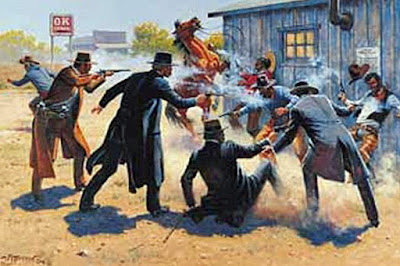
In my first group of history articles on this blog, I want to provide a flavor of my recent writing that I collected and self-published in three electronic books available for reading on my website, ringbrothershistory.com , under “Bob’s Projects.”  This article is adapted from Southeastern Arizona Reflections - Living History from the Wild West. Over a period of a little more than 25 years, from the late 1870s to the early 1900s, southeastern Arizona earned its legendary reputation of being the “Wild West.”  The time was characterized by fierce Apache resistance, increased ranching operations, rapidly growing mining boom towns, smuggling and cattle rustling across the U.S.-Mexico border, and a blooming network of stagecoach lines and railroads. Besides Apache raids across southeastern Arizona until 1886, Cochise County, and particularly Tombstone, was where most of southeastern Arizona’s Wild West action was.  There was considerable tension between the rural res...